Our Global Network of Bioreactors

By deploying our small Direct Air Capture (DAC Everywhere™) bioreactors in cities and towns around the world, we can take the equivalent amount of carbon dioxide (CO₂) out of the air as if we had planted thousands of forests around the world.
Climate change can seem like an insurmountable problem without a solution. The production of global greenhouse gases is exceedingly difficult to tackle; there are too many competing interests and too many stakeholders, making the problem appear impossible to fix. The scale of the problem is unprecedented and the challenges we face in attempting to solve this problem can be extremely daunting. However, without a viable global solution to fix this problem, we face a more uncertain and potentially catastrophic future.
Our efforts to battle climate change thus far have been inadequate, disjointed and inefficient at best.
We need a paradigm shift –
Thinking Big by Building Small
If we change our perspective to solving this global problem at a targeted, localized level the problem no longer seems insurmountable, but solvable, with a solution that is both viable and achievable in a relatively short period of time.

STRATEGIC DEPLOYMENT: IN CITIES EVERYWHERE
We plan to tackle the problem of climate change at its source – in cities across the globe.
“According to UN Habitat, cities consume 78 per cent of the world’s energy and produce more than 60 per cent of greenhouse gas emissions.”
Generating power | United Nations
A recent scientific study done at the Norwegian University of Science and Technology (NTNU) found that 18% of all global emissions come from just 100 cities.
New study estimates the carbon footprints of 13,000 cities (sciencenorway.no)
Our solution is simple. Since cities and urban areas are major producers of global greenhouse gas emissions, we plan to tackle the problem of climate change at its source.
However, many of the current Carbon Dioxide Removal (CDR) projects are being built in areas where land is cheap and available, areas where little CO₂ is being generated. These projects are resource intensive, requiring large amounts of capital and land, and years of planning. Unfortunately, even after billions of dollars have been spent on such projects, having the largest DAC facility in the world still does little to address the problem of climate change on a global scale.
We believe there is a better way forward to addressing this problem at its core: thinking big by building small.

We believe there is a better way forward to addressing this problem at its core: thinking big by building small.
By deploying our small DAC units everywhere all at once, simultaneously and concurrently, targeting the areas with the highest emissions of CO₂ (urban areas) and deploying our bioreactors at thousands of these sites around the world, we can create a network of bioreactors spanning the globe. We can address the problem of climate change on a systemic level; our network of bioreactors will meaningfully impact the levels of CO₂ in our air that have been skyrocketing since the Industrial Revolution. At full global deployment, this network will dramatically reduce the CO₂ levels in our air globally with the goal of creating a global environment with negative emissions, a process that would remove more CO₂ from our air than we are generating.
We can do this.
Together, working with local governments and stakeholders around the world,
we can solve climate change.

Building a Global Network of Photobioreactors

We will not be selling our bioreactors to the public or to anyone else. Our network of bioreactors will be built, owned and operated by The Canterhill Carbon Project. Our goal is to build, deploy, and maintain our bioreactors for the sole purpose of removing carbon dioxide from the air.
We will be working closely with local governments in cities, town and municipalities around the world to ensure optimal placement of each bioreactor. We envision our bioreactors placed on public and private buildings, rooftops, billboards throughout cities and on heavily traveled transportation routes. We plan to utilize and capitalize on existing infrastructure in order to create a network that will yield optimal results in its rate of CO₂ capture, while ensuring we can build and deploy our network safely and quickly in order to mitigate the worst effects of climate change.
We will be creating partnerships with local governments, and their national counterparts, as well as international governing bodies such as the United Nations, in order to build out this network as effectively, efficiently and quickly as possible.
Strategic deployment: urban integration
How to Best Utilize Existing Infrastructure
Regarding how and where our bioreactors are installed, the possibilities are endless. For efficiency, we plan to piggyback on existing infrastructure as much as possible. Our units, for example, could be placed inside illuminated advertisements at bus stops all over the city. We could be placed on the backs of billboards, on top of buildings, and under bridges. The possibilities are truly endless, and we would work closely with each municipality to determine the best placement for each unit.

BLENDING SEAMLESSLY INTO URBAN LANDSCAPES
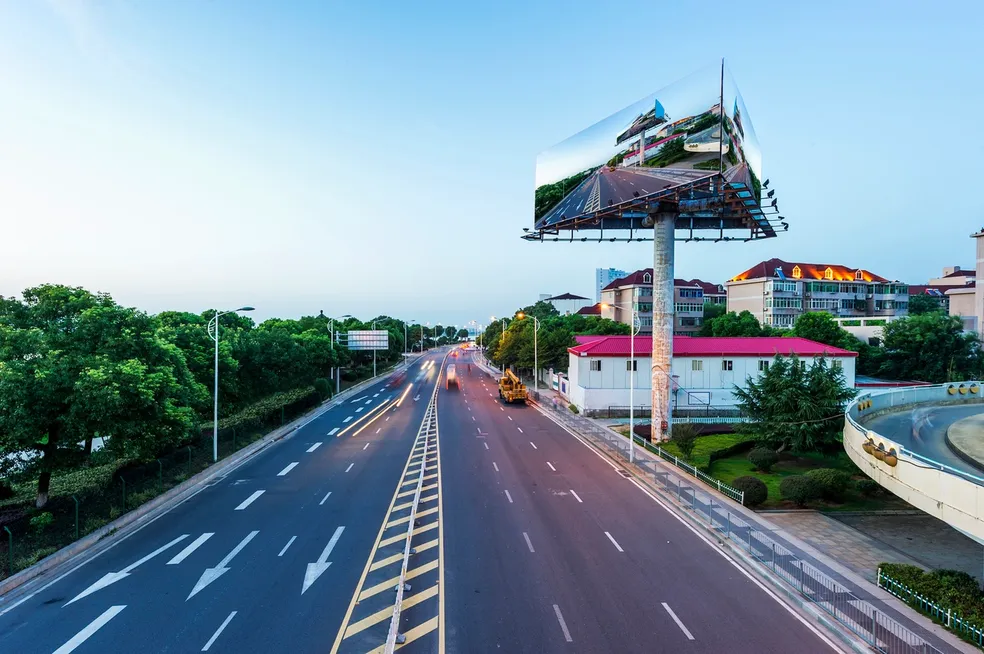
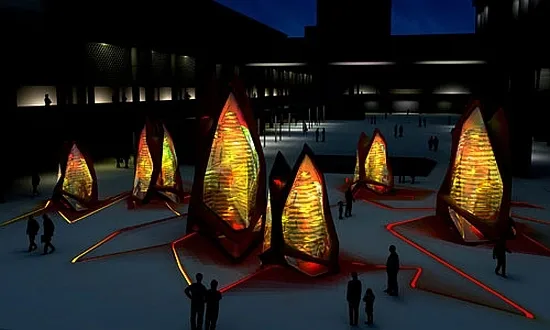


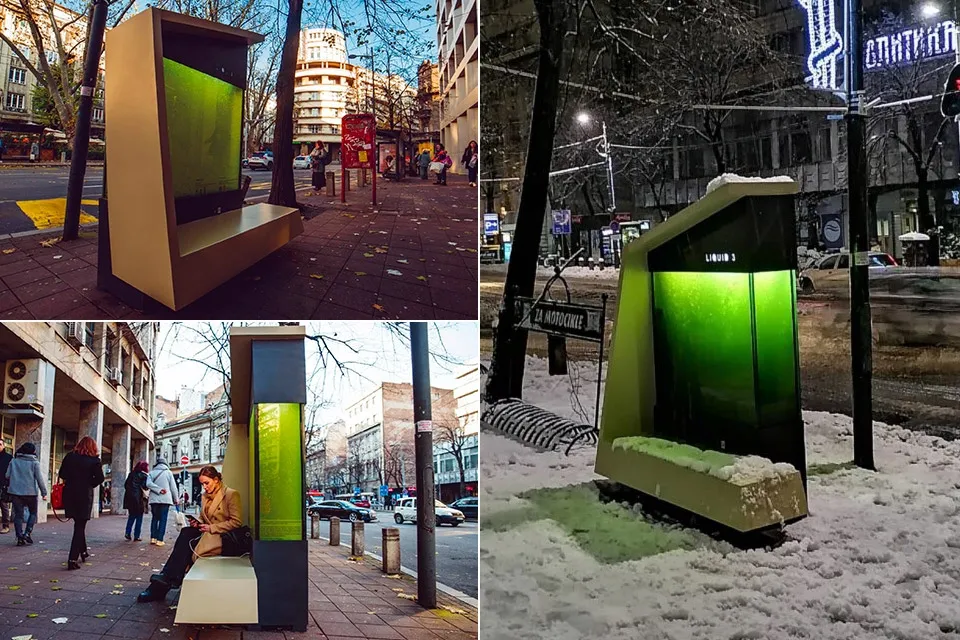


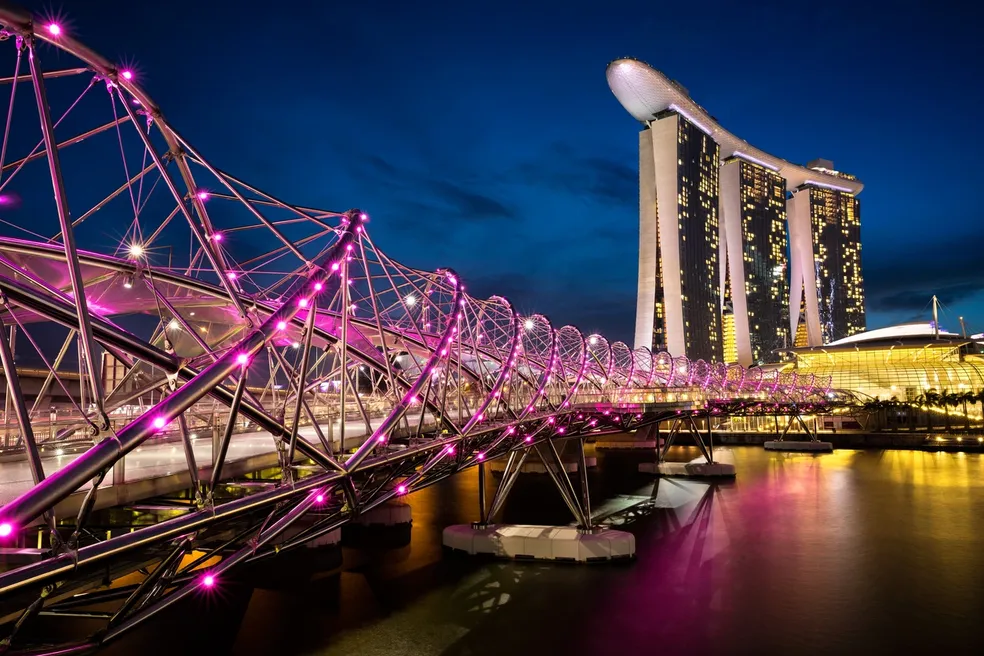
a safe solution to the climate crisis
A Solution Based on a Natural Process: Photosynthesis
Climate change is a result of the unchecked anthropogenically generated greenhouse gas emissions that have been released into our atmosphere for many decades. It was human activity that caused the problem; it is human innovation that will need to get us out of it. Unfortunately, the world’s response to climate change is currently fragmented and wholly inadequate. While there are numerous attempts to mitigate the worst effects of climate change, it is very apparent that what the world is doing in response to this crisis is not enough.
As the globe grapples with a way forward out of this crisis, attempts are being made to find ways to mitigate the symptoms of climate change, one of the symptoms being global warming itself. While our planet’s surface temperature continues to increase, it is becoming more and more difficult to rein in the effects of global warming, creating the spiraling crisis we are now contending with as a global community. As a result of this growing sense of urgency, some scientists are finding new and innovative ways to address the global warming issue in a manner that is raising some alarm bells.
A recent Wall Street Journal headline speaks for itself: “Scientists Resort to Once-Unthinkable Solutions to Cool the Planet”. The first paragraph goes on to say: “Dumping chemicals in the ocean? Spraying saltwater into clouds? Injecting reflective particles into the sky? Scientists are resorting to once unthinkable techniques to cool the planet because global efforts to check greenhouse gas emissions are failing.” These are innovative solutions, to be sure, but as they are meant to have a direct impact on our environment, by design, there may be unforeseen consequences to such innovative and novel experiments. Furthermore, these potential solutions for global warming fail to address the root cause of the problem.
While the climate change problem needs to be urgently addressed, we should proceed in the safest way possible. Utilizing proven technologies, our solution is a safe, no-risk solution that addresses not only the symptoms of climate change (i.e.- global warming), but the root cause: our skyrocketing CO₂ levels. Our only aim is to reduce global CO₂ levels, and we are doing this through the natural process of photosynthesis. Each unit is a completely closed system; the only impact on the environment will be a reduction in CO₂ levels in the area in which the unit is placed. Even if that closed system is breached, there is no possibility of adverse or unforeseen consequences, as algae is a naturally occurring organism that we will be breeding for the specific purpose of capturing and removing CO₂ from high-emitting urban areas.
To quote again the Wall Street Journal article referenced above, “Scientists are resorting to once unthinkable techniques to cool the planet because global efforts to check greenhouse gas emissions are failing.” Needless to say, in our quest to reduce greenhouse gas emissions and reach net zero, failure is not an option. The urgency of the situation will only grow by the day, and last year, 2023, had the highest rate of global CO₂ emissions ever recorded.
CO2 Emissions in 2023 – Analysis – IEA
Our project has the real potential to reverse the catastrophic and continual increase in global CO₂ emissions. Failure is not an option as the planet literally depends on our collective actions in the coming decades; we must act quickly, utilizing proven technologies and safe solutions to reach our net zero goals; and we must act now.
A Highly Controlled Solution

with measurable and verifiable results
The beauty of our solution is that it is completely controllable, down to the micro level; each unit can be turned on and off at any time. Should there be a need to scale back our efforts, we would be able to do so on a very localized basis; likewise, should there be a need to scale up our efforts, we could do so on a localized, national or international level as well.
We will be constantly monitoring our CO₂ removal numbers in relation to the needs of the local area we are deployed in, as well as the overall national and global efforts to reach net zero. This allows for much more control over CO₂ levels locally, nationally and internationally, making the climate crisis more manageable with an effective and efficient solution that will have a verifiable impact on our global carbon footprint.
dac carbon dioxide removal
What We Are Doing

- We are creating a decentralized CO₂ removal network on a global scale by using numerous smaller DAC bioreactors (approximately the size of a mini refrigerator) spread out over 1,000s of different locations.
- We are working towards miniaturizing our bioreactors to the size of a pizza box while simultaneously increasing its ability to capture more CO₂ from the air.
What They Are Doing

- Others are building large scale and very expensive carbon dioxide removal projects in single locations often in rural areas where real estate for such projects is available and relatively inexpensive.
- What they are doing is done from one location which provides very limited and localized benefits and is not a truly global solution to a global problem. (Our solution is global by design and practically unlimited in scope as we scale up.)
Effective Carbon Removal Must Be:
- Measurable ✔️
- Verifiable ✔️
- Scalable ✔️
- Affordable ✔️
- Permanent ✔️
- Additive ✔️ (something that does not occur naturally or will happen anyway)
why what we are doing is better
By deploying our DAC Everywhere™ bioreactors in major population centers around the world, we can effectively remove a much larger amount of CO₂ globally at a significantly lower price.
What we are doing is better because our decentralized approach is by far more effective in removing a larger quantity of CO₂ from the air by being at the source of where the most CO₂ is being produced: in densely populated and industrialized areas.
We have a truly global solution that will have global results. In contrast, the world’s largest DAC facility in Iceland will have near zero impact on CO₂ levels in China, India or South America for example.
There is only a finite amount of CO₂ (0.04% of our atmosphere) that can be removed from any one location until it becomes progressively more difficult to remove additional CO₂ from the air. Unless placed near a carbon dioxide emitting source, large carbon dioxide removal facilities will all face this problem as they scale up their operations.
By deploying our DAC Everywhere™ bioreactors in major population centers around the world, we can effectively remove a much larger amount of CO₂ globally at a significantly lower price.

A Decentralized Approach
DAC Everywhere™
Our Bioreactors
- Our DAC Everywhere™ units work by integrating both natural and mechanical solutions into one. They will be robust by design, easy to manufacture and mass produced at a relatively low cost.
- We developed our DAC Everywhere™ units based on proven technology that works.
- A DAC Everywhere™ unit is essentially a photobioreactor utilizing the photosynthesis process to remove CO₂ from the air. Each DAC Everywhere™ unit will have the ability to remove the equivalent of dozens of mature trees worth of CO₂ from the air.
- Each unit is about the size of a mini refrigerator, taking up the equivalent space required by approximately one mature tree, thereby significantly reducing the space, time and cost requirements when compared to planting a new forest (or building a giant algae farm).
- We plan to deploy our DAC Everywhere™ technology in densely populated cities around the world, the very locations that are responsible for generating the largest amounts of CO₂ emissions, tackling the problem globally at its source where CO₂ production is at its highest.
- This is something that no one else is attempting to do on a global scale until now.
OUR vision
To create a global network of millions of bioreactors in cities around the world that will significantly reduce CO₂ levels globally in a measurable and verifiable way.

Our Algae: Resilient and Effective
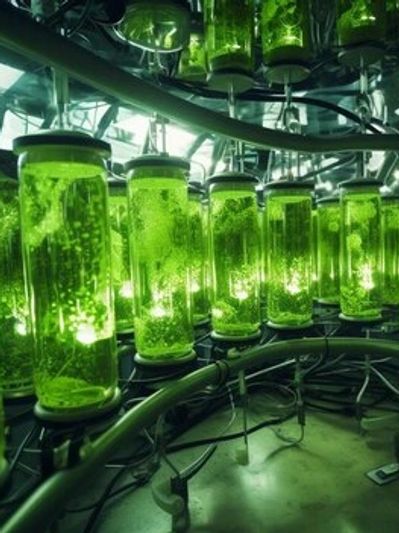
Our algae is individually designed to remove CO₂ from the air more effectively and efficiently than most any other organism.
We custom design a specific algae for use at a given location. We use enhanced carbon fertilization in order to optimize the photosynthesis process and remove the most amount of CO₂ possible in the environment it is deployed. In Canada, for example, we use different types of algae in the summer than we would in winter due to seasonal temperature differences.
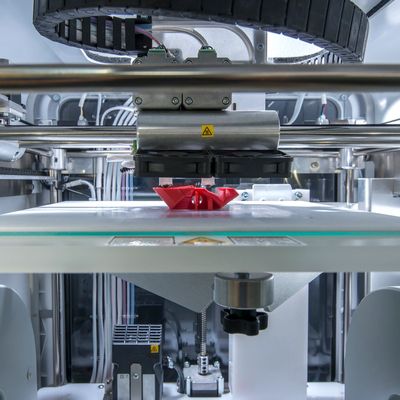
We create our custom designed algae using our proprietary 3D biological printer. We find this to be the most efficient way to manufacture the precise type of algae we need for our DAC Everywhere™ units.
We grow our algae in an AI controlled system inside our DAC Everywhere™ units, thereby ensuring a high quality and clean algae harvest.
As light facilitates the photosynthesis process, each unit utilizes artificial light to allow for the photosynthesis process to occur around the clock. This significantly increases each unit’s total carbon removal capability by effectively almost doubling the amount of time each organism is exposed to light.
3D BioPrinted Algae
We use cutting edge 3D bioprinting technology to create our custom genetically engineered algae.
Our custom designed algae will have the ability to thrive in any location we choose to deploy our DAC Everywhere™, thereby optimizing its ability to remove CO₂ in any environment.
We continue to experiment and develop our proprietary 3D bioprinting technology to minimize the time required to produce the algae.
We are currently exploring possibilities of scaling up our 3D bioprinting capabilities for mass production outside laboratory conditions.
Work continues with our research partners to develop the most effective algae to achieve our goals.
OUR ALGAE CAN THRIVE ANYWHERE





the science behind our project
Our project utilizes proven technologies backed by science & nature
Algae: a proven carbon dioxide capturer
Frontiers
MDPI
Nature
Oxford Academic
Oxford Academic
Microalgae: The Potential for Carbon Capture | BioScience | Oxford Academic (oup.com)
ScienceDirect
ScienceDirect
Minimizing carbon footprint via microalgae as a biological capture – ScienceDirect
bioreactors: a proven technology
IOPscience
MDPI
ScienceDirect
Carbon dioxide capture and use by microalgae in photobioreactors – ScienceDirect
ScienceDirect
Carbon sequestration in microalgae photobioreactors building integrated – ScienceDirect
ScienceDirect
Design and applications of photobioreactors- a review – ScienceDirect
ScienceDirect
ScienceDirect
Photobioreactor – an overview | ScienceDirect Topics
Wiley Analytical Science
FAQs
Will your technology work?
Absolutely. The work we do is based on proven technology based on decades of research and billions of dollars of investment in the past. We are building upon established technology; there is no doubt that our technology works. At its core, our bioreactor harnesses the power of nature to capture carbon dioxide through photosynthesis. Our bioreactor enables algae’s unrivaled natural ability to remove carbon dioxide from the air. Each bioreactor provides a controlled environment for our algae to thrive and optimize its photosynthesis process.
How much energy will each bioreactor need?
We are constantly working towards optimizing the efficiency of our bioreactors. Our present target is to get each bioreactor to operate at 60W. Our goal is to further reduce this power consumption over time. We are looking into the possibility of generating electricity with generators using the biofuel we produce to power our network of bioreactors.
Will the energy used to operate the bioreactors increase GHG emissions?
No, our bioreactors will run on renewable energy so as to not add to GHG emissions. Part of the research and development we do is to work towards minimizing the energy requirements of each bioreactor.
are your bioreactors available for sale to the public?
Our network of bioreactors will be built, owned, and operated by The Canterhill Carbon Project.
As time is of the essence when dealing with the climate crisis, it is our aim to scale up the manufacturing capacity of our bioreactors as quickly as possible. As we do so, each unit will need to be strategically placed in highly populated areas as part of our global network. Furthermore, each unit will need frequent servicing as the algae will need to be harvested on a consistent basis so that we can keep the rate of CO₂ capture and removal as high as possible. For these reasons, we will not be selling our bioreactors to the public, or to anyone else.
Instead, we will be working with local governments to determine the safest and most secure placement of our units. We will be coordinating closely with local and national governments and international bodies to create a global network capable of capturing the most CO₂ in the shortest amount of time in order to reach our global net zero objectives.
At some point in the future, when our global carbon exchange is online, we invite the public to purchase our carbon credits. Each of our carbon credits represent a precise amount of CO₂ removed from the air; the amount of CO₂ captured is easily verifiable and measurable through our algae harvesting process. Since our carbon credits will be reliable, measurable and verifiable, our carbon credits will be of the highest quality available anywhere. We understand that the global community would like to help mitigate climate change, and purchasers of our carbon credits can be confident in the positive impact on the environment that their purchase will make.